Giving our iXpro Series a Face – How we expanded our embedded platform with GUI capabilities
The requirements for modern embedded systems are changing. Today, a classic embedded gateway no longer only handles connectivity tasks – it must also increasingly be operable locally. With a recent milestone, we have expanded our iXpro® platform with precisely this capability: Graphical user interfaces (GUI) directly on the embedded gateway – including touch display support.
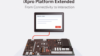
From a pure embedded gateway to an interactive system controller
Traditionally, embedded gateways operate in the background. They connect sensors, actuators and cloud systems, but remain invisible to the end user. However, many IoT applications are giving rise to new requirements:
- Local configuration on the device
- Touch-based operation
- Visualisation of system states
- Interactive system controllers with display
Instead of integrating an additional hardware unit or switching to more powerful platforms, we deliberately chose a different path: expanding our existing iXpro® embedded platform.
The technical challenge: GUI on the NXP i.MX93
The processor base used – including the NXP i.MX93 – is primarily designed for energy-efficient embedded applications. A dedicated high-end GPU for complex graphics applications is not the focus here.
The classic solution would have been:
- Use more powerful hardware
- Change the architecture
- Increase costs
However, our goal was different: to enable GUI support within the existing dual-core architecture.
Through the targeted use of the dual-core structure and a GPU emulation approach in the NXP environment, we were able to run graphical interfaces stably on the system – based on Embedded Linux.
One core handles the application logic, while the second core supports the graphical processing.
The result:
- Stable GUI display
- Touch display integration
- No fundamental change to the platform architecture
Platform thinking instead of feature thinking
This milestone is not an isolated project feature. It is a strategic extension of the iXpro® platform. Specifically, this means:
- The same embedded architecture can be used as a pure gateway or as an interactive system controller
- OEMs can implement different product variants on the same basis
- Hardware fragmentation is reduced
- Development cycles remain plannable
Our platform grows with requirements without the need to create a new system basis each time.
Greater flexibility for OEMs and device manufacturers
This offers clear advantages for manufacturers in the smart home, building automation and Industry 4.0 sectors:
- Visualisation directly on the embedded system
- Interactive user interfaces without additional hardware
- Cost efficiency through reuse of existing platform components
- Scalability from ‘headless gateway’ to ‘gateway with display’
Instead of developing separate device generations, a consistent embedded platform can cover multiple application levels.
Developed from real project requirements
Like many sustainable enhancements to our platform, this capability did not arise from a theoretical roadmap, but from a specific customer requirement.
It was important to us not to implement the solution as a one-off adaptation, but to structure it in such a way that it could be reused.
This is how our embedded platform continues to evolve – practical and architecturally stable.
iXpro®: More than connectivity
With the GUI extension, our iXpro® series goes one step further:
- Wireless & connectivity
- Certification preparation
- Modular hardware basis
- Embedded Linux
- And now also graphical user guidance
A pure embedded gateway becomes a visible, interactive system. And a platform becomes an even more flexible basis for future IoT products.
Outlook
The GUI functionality is currently available on a project basis and is being further developed. Our goal remains clear: a scalable embedded platform that can be adapted to new requirements without losing its architectural stability. Because modern IoT systems don’t just have to connect. They have to be expandable.

DSR ithinx Joins ZBOSS Open Initiative and Integrates ZBOSS Unified Zigbee Stack into iXpro SOM

NXP ithinx Embedded World A year of exciting innovation: 2024 with ithinx